Egg
Expanding reference. What eggs are, what they do, every major preparation family, the why behind technique. Guatemala-specific throughout. Evolves with the kitchen.
The Two Eggs at Market
| Large white (commercial) | Criollo (gallina criolla / india / huevo de patio) | |
|---|---|---|
| Source | Granja layer hens (Hy-Line, Leghorn, ISA) | Backyard / free-range, mixed breeds |
| Feed | Standardized corn + soya + vit premix | Scraps, bugs, maíz, hierbas, varied |
| Weight | 55–63 g | 35–45 g (pullet eggs as small as 25 g) |
| Shell | Thin, uniform white | Thicker, white/cream/brown, sometimes pale blue-green (Araucana lines) |
| Yolk | Pale yellow, ~30% of egg | Deep orange, ~40% of egg, more carotenoids + omega-3 |
| White | Watery, spreads | Firmer, holds shape |
| Flavor | Neutral | Concentrated, sometimes faintly grassy |
| Freshness at sale | Days–weeks (cold chain) | Often <48 h |
| Price (Apr 2026) | ~Q35–45 / cartón of 30 | Q1.50–2.50 each at SM tiendas |
Substitution rule: 3 criollos ≈ 2 large whites by weight. Criollos punch above their mass for richness — more yolk per gram, denser albumen.
Float test: sinks flat = very fresh. Stands on end = ~2 weeks, still good. Floats = bad.
Room temperature principle: Eggs at room temp cook more evenly, emulsify more reliably, foam better. Cold-straight-from-fridge eggs have a more dramatic white/yolk temperature differential — the white sets before the yolk gets up to temp. For most applications, pull eggs 20–30 min before use if refrigerated.
Freshness and Application
Counterintuitively, fresh eggs are not always best. The right age depends on what you're doing.
Fresher is better for: fried eggs (firm white that holds), poached eggs (cohesive white, no threads), scrambled (richer flavor), anything where yolk richness matters, chawanmushi.
Older is better for: hard-boiling (easier peeling — see Peeling section), beaten whites (foam better as protein structure slightly loosens), mayonnaise (easier emulsification).
For poaching specifically: the freshest egg you have. The white of a fresh egg is more viscous and cohesive — it wraps around the yolk rather than trailing off into threads. The white vinegar / vortex techniques are partly compensating for what fresh eggs don't need.
For frying: medium-fresh. Very fresh criollos have extremely firm whites that can set unevenly (clear-to-opaque ring problem on the outer edge). 3–5 days old is the sweet spot for a clean sunny side.
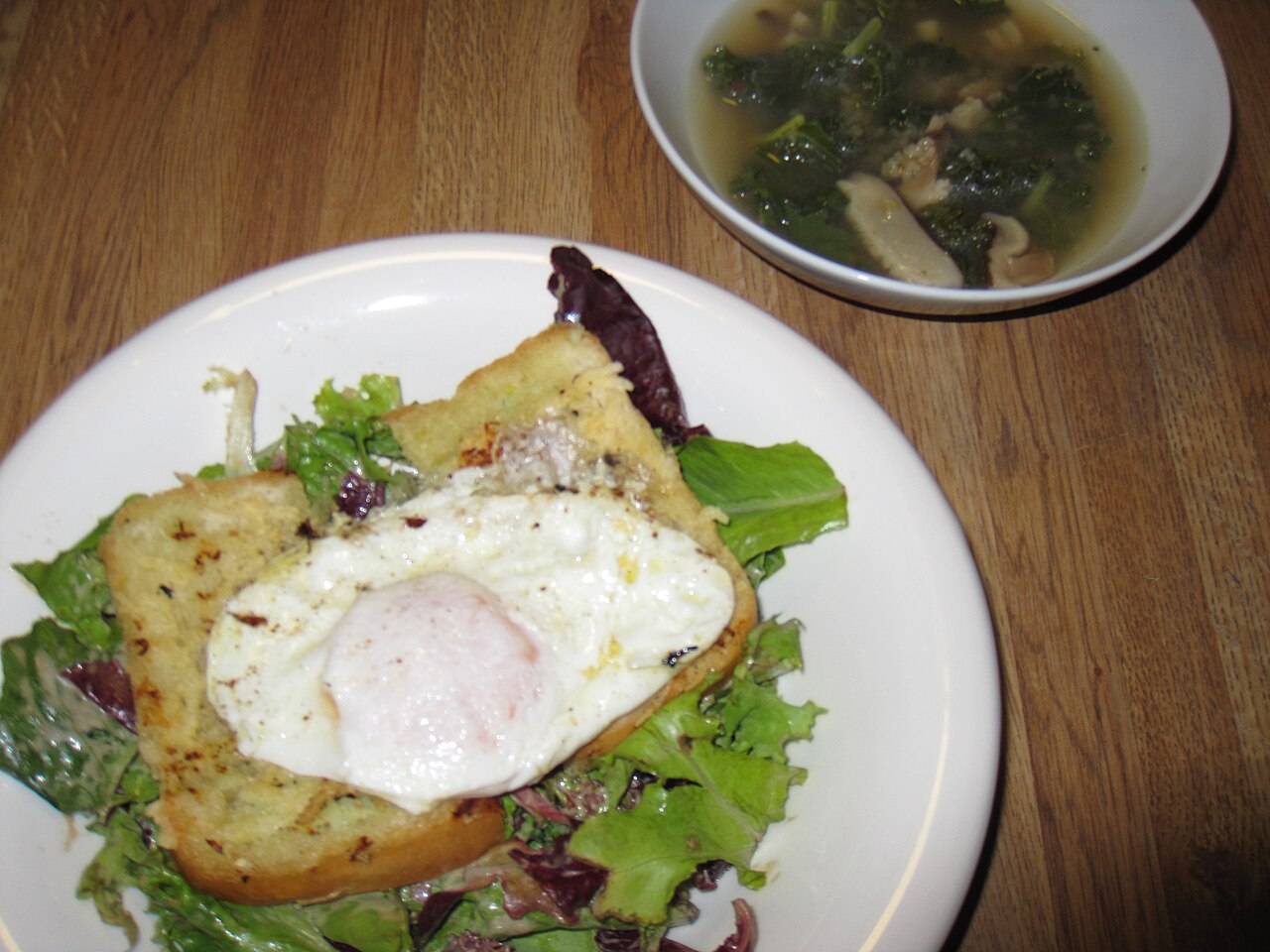
Peeling — The Real Problem
The peeling difficulty with criollos is freshness, not the shell.
Fresh egg whites have a low pH (~7.6) and the albumen bonds tightly to the inner shell membrane. As eggs age, CO₂ escapes through the porous shell, pH rises (toward 9.2), proteins release. Supermarket eggs peel cleanly because of age.
Three Solutions
- Wait. Let criollos sit in the fridge 3–5 days before hard-boiling.
- Steam them. Thermal shock breaks the protein-membrane bond mechanically regardless of freshness.
- Pressure cook 5-5-5. 5 min pressure / 5 min natural release / 5 min ice bath.
Vinegar/salt in water = marginal. Mostly ensures cracks coagulate fast.
Adding baking soda (½ tsp per liter boiling water): raises water pH, which raises egg white pH slightly, reducing membrane adhesion. Low-effort, works reasonably well. Worth trying before the age-and-steam approaches.
Hard and Soft — Boiling and Steaming
All times +30 sec at lake altitude (1600m, water boils ~94°C).
| Method | Criollo (35–45g) | Large white (55–63g) | Notes |
|---|---|---|---|
| Boil from boiling water | 8 min hard / 6 jammy / 7 just-set | 10–11 / 7 / 8–9 | Standard fallback |
| Steam from boiling water | 9 min hard / 7 jammy / 8 just-set | 12 / 9 / 10 | Best for fresh criollos |
| Pressure 5-5-5 | 5 cook + 5 NR + 5 ice | same | Bulk batches |
| Low-temp 70°C / 45–60 min | — | — | Japanese onsen style. Jammy white + flowing yolk |
| Onsen 63°C / 75 min | — | — | Just-set white + liquid-creamy yolk. The precision version |
Boiling protocol: lower with spoon (don't drop), splash of vinegar optional, time from re-boil, into agua con hielo 3–5 min, peel from wide end under running water.
Steam protocol: 2 cm water in pot (doesn't need to cover eggs), steamer basket or three foil balls + plate, bring to hard boil with lid on, add eggs, lid back on, time from when eggs go in. Ice bath same.
Fried
Sunny Side Up
Low-to-medium heat. Oil or butter. Crack egg into pan. Lid on for 30 sec if you want the top set without flipping (steam from the pan does it). Done when white is fully opaque and yolk is still liquid — test by pressing yolk gently with fingertip.
Criollo fried egg: the deep orange yolk is the visual. Use a small pan that fits the egg, or the white will spread thin and set faster than you can manage it. Medium-low heat — the thick firm white of a fresh criollo can handle longer lower heat without crisping.
Over Easy / Over Medium / Over Hard
Sunny side method, then flip once gently. Spatula flat under the whole egg, single smooth motion. Easy = 10–15 sec yolk-side down (yolk still runny). Medium = 30 sec (yolk jammy). Hard = 60+ sec (yolk set).
Crispy Fried (Lace Edge)
High heat. More oil than you think (4–5mm in the pan). When oil is shimmering-hot, crack egg in carefully — it will sputter. The white sets immediately, bubbles at the edges, turns lacy and golden-brown. Baste the yolk with hot oil from the pan using a spoon. Done in 60–90 sec. The underside is crisp; the yolk remains runny under the oil film. This is sabich-style, also the Spanish huevo frito at its best. The lace edge is not a mistake — it's the point.
Guatemalan Huevos Estrellados / Al Gusto
Medium heat, oil or manteca, no lid, white fully set, yolk runny. Served with black beans, tortillas, crema, queso fresco, avocado. The egg is not the star — it's infrastructure for the bean plate.
Scrambled
These are three different dishes that share an egg-beating step. Not interchangeable.
French Scrambled
The patience method. Low heat. Butter. Beat eggs with a fork — not a whisk (whisking incorporates too much air; the French version is dense, not fluffy). Pour into cold or slightly warm pan. Medium-low heat, stir constantly with a spatula. Never let it sit still. Remove from heat periodically if it's moving too fast. The goal: a uniform, glossy, barely-set mass with a consistency between very soft curds and a thick sauce. Takes 5–8 min. Finish off heat with a small pat of butter or crema. Salt at the end — salt added to beaten raw egg draws water, weakens protein bonds, gives a wetter, less custardy result.
American Scrambled
Medium heat. Oil or butter. Beaten eggs with a splash of milk or water (milk = richer, water = lighter). Pour in. Fold periodically with spatula, large slow movements. Larger curds, less attention-intensive. Done when set but still glossy — there is residual carryover heat. Remove from pan 30 sec before they look fully done.
Chinese Stir-Fried (滑蛋 / Wok Egg)
High heat. Neutral oil, generous. Beat eggs with a pinch of salt and a few drops of sesame oil. Optional: tiny pinch of sugar (heightens the egg flavor). Pour into a very hot wok. Let it set 3–4 seconds on the bottom, then fold large, pulling from the edges to center. It should be in motion most of the time. Remove when still 80% set — the residual heat in the pan and the egg itself finishes it. The goal is large, glossy, custardy pillows with a slight smoky edge. This is also the egg technique for Pad Thai and Cantonese ho fun — see cross-ref rice-noodle.
Poached
The fundamental requirement: fresh egg. A fresh egg's white is viscous and cohesive; it wraps around the yolk. Older egg whites are watery and trail.
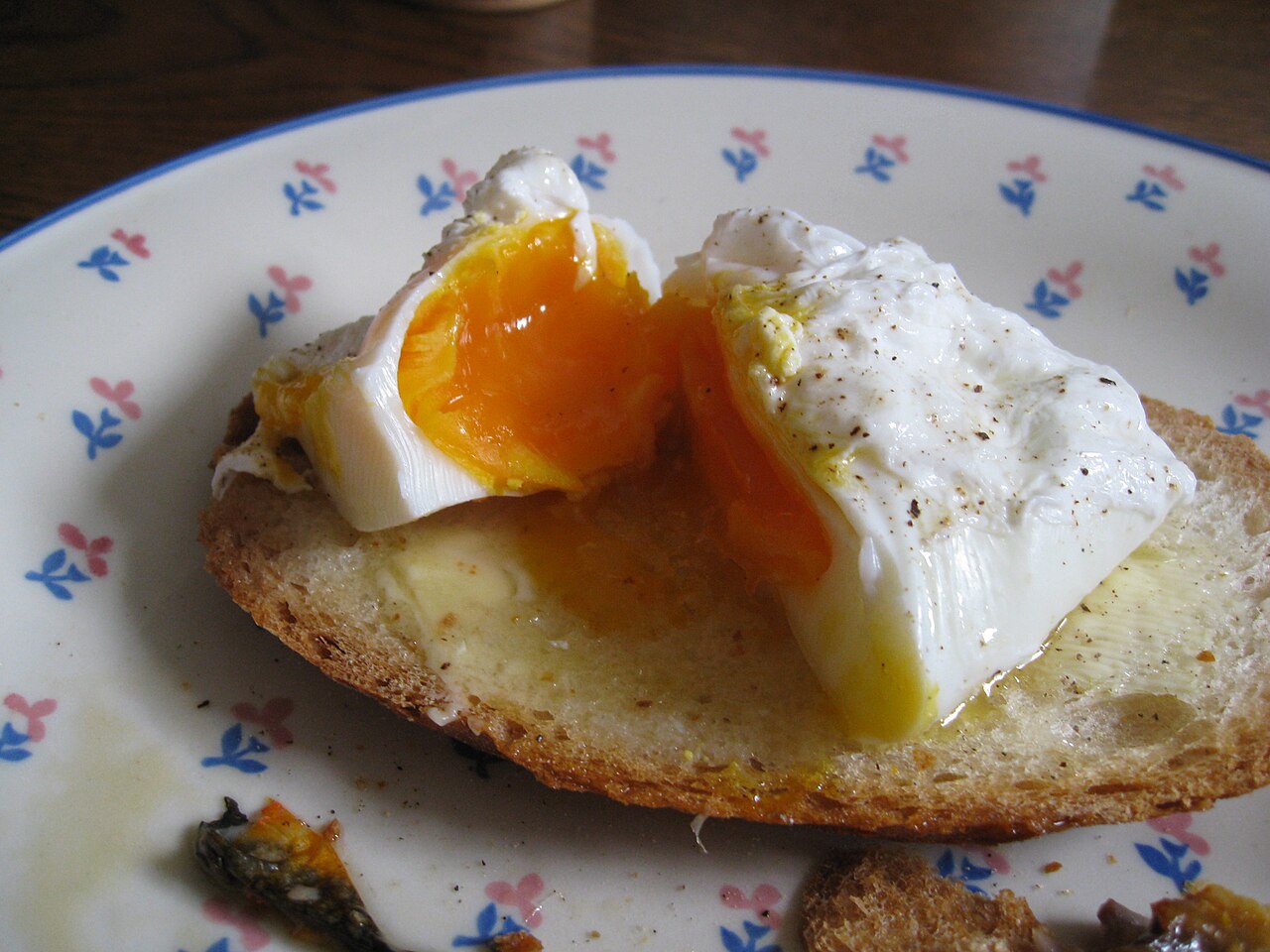
Standard Poach
Water at 80–85°C (visible shimmer, small bubbles forming, not rolling boil — at altitude this is harder because 94°C is your boil, so simmer at low flame and aim for visible but gentle movement). Add white vinegar, 1 tbsp per liter. This lowers water pH, which accelerates white coagulation and reduces the trailing-thread problem.
Vortex method: create a gentle whirlpool in the water with a spoon, then drop the egg into the center. Centrifugal force wraps the white inward around the yolk. Works well; requires some pan size to execute. For multiple eggs, don't use the vortex — cook one at a time or use ramekins.
Ramekin / small cup method: crack egg into a small cup or ladle first. Lower cup into simmering water until the white starts to set at the edges (5–10 sec), then tip gently — the egg holds its shape better because it's already partially committed. Less theatrical than the vortex, more reliable for multiple eggs.
Plastic wrap method: line a ramekin with plastic wrap, rub with oil, crack egg in, tie off the wrap, drop into simmering water. 4–6 min. Produces a perfectly round, clean poached egg with no threading at all. Functional, slightly industrial. Works for advance prep (hold in ice water, reheat in hot water at service).
Shirred and Baked
Shirred (oeufs en cocotte): butter a ramekin, crack egg(s) in, add a spoonful of crema or coconut milk, pinch of salt. Bake in a bain-marie (water bath) at 180°C, 12–15 min until white is just set and yolk still liquid. Or: steam on stovetop — set ramekin in a covered pan with 2 cm of simmering water, same time. The bain-marie is critical: direct oven heat without water bath will cook the bottom and sides before the top sets.
Variations: add cheese on top (goes golden), add a spoonful of sofrito or chimichol salsa under the egg (the salsa underneath becomes a sauce), add loroco buds (Guatemalan — they steam and release flavor into the egg).
Eggs in tomato sauce (huevos en chirmol / shakshouka logic): make the sauce first — tomato, garlic, chile, onion, cooked down. Create small wells in the sauce, crack eggs directly in, cover the pan, cook on low 5–8 min until whites set and yolks still run. The egg poaches in the tomato. Works with recado colorado for a Guatemalan version.
Omelet Families
French Omelet
The canonical test of technical skill. 2–3 eggs, beaten smooth, no added liquid. Medium heat, butter. The moment butter foams (not browns), pour in. Use a fork or heatproof spatula to stir the setting egg in continuous small circles while shaking the pan — this keeps everything moving and creates very small uniform curds. When the bottom is set but the top is still very wet, stop stirring, let it sit 10 sec for a thin set. Then roll — tilt pan, fold one edge over center with spatula, roll onto plate so it seams shut. The outside should be barely set, pale yellow, no browning. Inside: barely-set, almost custardy. This takes practice. The cue is: if it browns on the outside, the heat is too high.
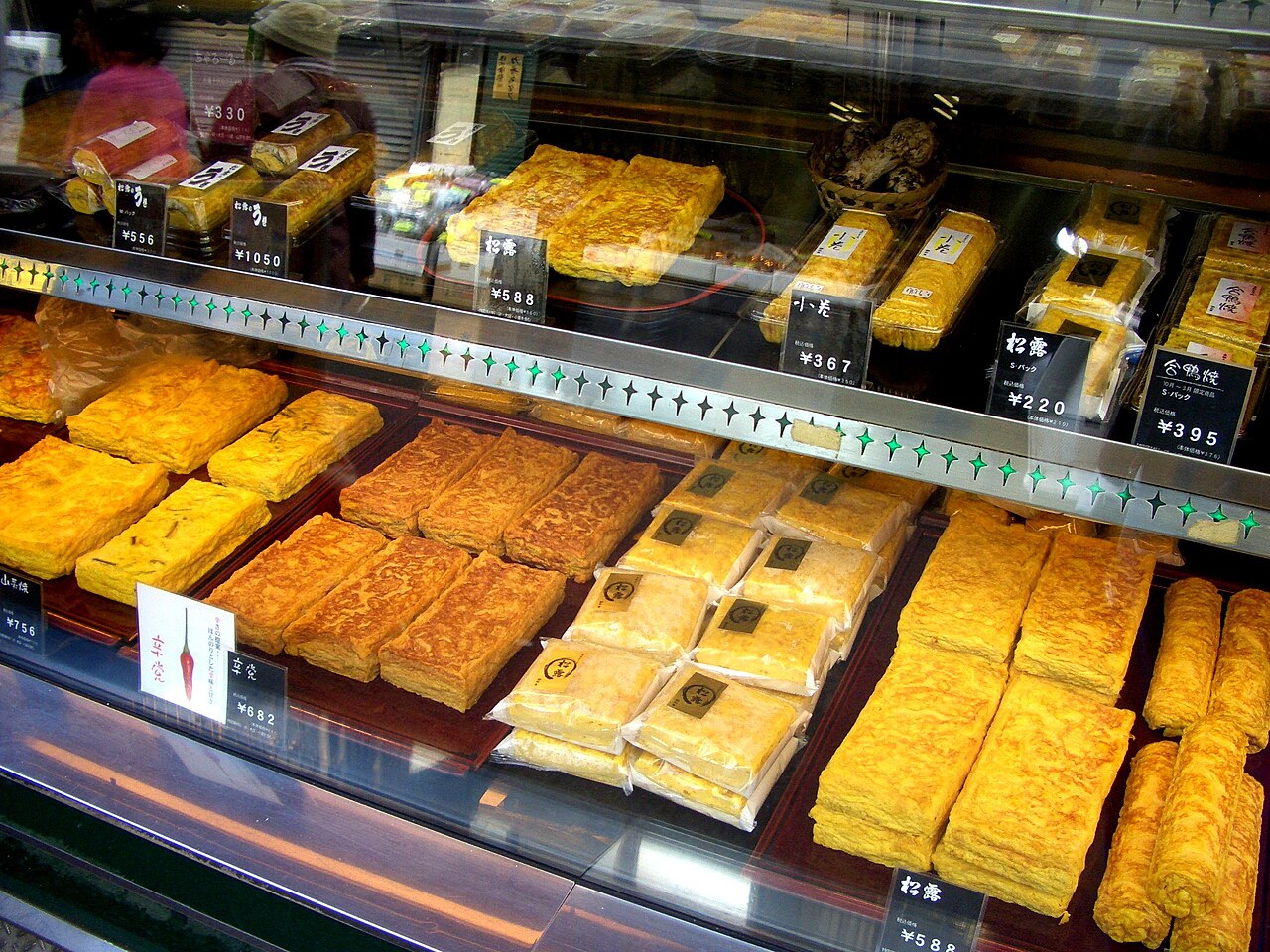
Tamagoyaki (Japanese Rolled Egg)
Beat 2–3 eggs with dashi, mirin, soy (or sugar instead of mirin), a pinch of salt. Sweet, savory, or somewhere in between depending on ratio. In a rectangular tamagoyaki pan (rectangular = the tool; a small skillet works but shaping is harder), pour thin layer of egg, let bottom set, roll it up to one end. Pour second thin layer, let it set under the first roll, roll again. Repeat until egg is used. Result: a compact rolled log with visible layers when cut. The layering is the visual. This keeps refrigerated 2–3 days and is eaten at room temperature as part of a Japanese bento — one of the few egg preparations intended to be eaten cold.
Tortilla Española
4–6 eggs + 2 large potatoes (peeled, thin-sliced or cubed) + 1 onion (optional — the Madrid-vs-San Sebastián debate). Poach potato and onion together in abundant olive oil on low heat until soft (not fried — 15–20 min at very low temp). Drain, reserving the oil. Beat eggs, fold potato/onion in, salt generously. Pour into the same pan (with a small amount of the reserved oil) on medium-low heat. When the bottom sets, flip the entire tortilla — a plate on top of the pan, invert, slide uncooked side back in. 3–5 min more. Center should still be slightly soft when you pull it — it firms as it rests. Serve at room temp, cut in wedges.
At the lake: without the potato-poaching oil volume, use a neutral oil + splash of olive for flavor. The technique works on a gas stovetop. A heavy pan (cast iron or thick-bottomed nonstick) helps the flip.
Guatemalan Variations
Huevos rancheros: fried eggs (over easy or sunny) on a warm tortilla, covered with a tomato-chile salsa made separately. The egg and salsa don't cook together — they meet at service. The distinction matters: this is not huevos en chirmol (where the egg poaches in the sauce).
Huevos divorciados: two fried eggs on two separate tortillas, one covered in red salsa (tomate + chile rojo), one in green salsa (tomatillo + chile verde). "Divorced" because the sauces are kept separate by a wall of frijoles between the two. The presentation is the dish.
Huevos en chirmol: eggs cooked directly in chirmol (a Guatemalan tomato-chile sauce with a specific char-and-grind technique). The sauce typically has tomato, miltomate, chile, cilantro. Roast or char the tomato and chile first, then grind (mortar or blender). The charred flavor is key — this is not a raw-tomato sauce. Eggs in, cover, low heat, 5–8 min.
Egg Drop Technique
Beaten egg poured in a thin stream into a hot, near-simmering broth or sauce while stirring constantly in one direction. The egg threads set immediately in the heat. The broth should not be at a full rolling boil — violent movement shreds the threads into foam.
Cantonese egg drop soup (蛋花湯): thickened broth (cornstarch slurry first) so the egg threads stay suspended rather than sinking. The starch gives the characteristic silky consistency.
Italian stracciatella: same principle, no starch. Egg + parmesan + nutmeg beaten together, dropped into simmering broth. Rougher, more ragged threads — the name means "little rags."
Thai egg in hot-and-sour soup: egg dropped into the soup in the last 30 sec, not stirred — just swirled gently to create ribbons. Slightly different from Chinese method — less stirring = larger, looser ribbons.
Into rice noodle soup: crack one raw egg directly over the bowl, let the hot broth half-set it. Or stir the beaten egg into the soup pot in the last minute. See rice-noodle — egg drop section.
Custard Family
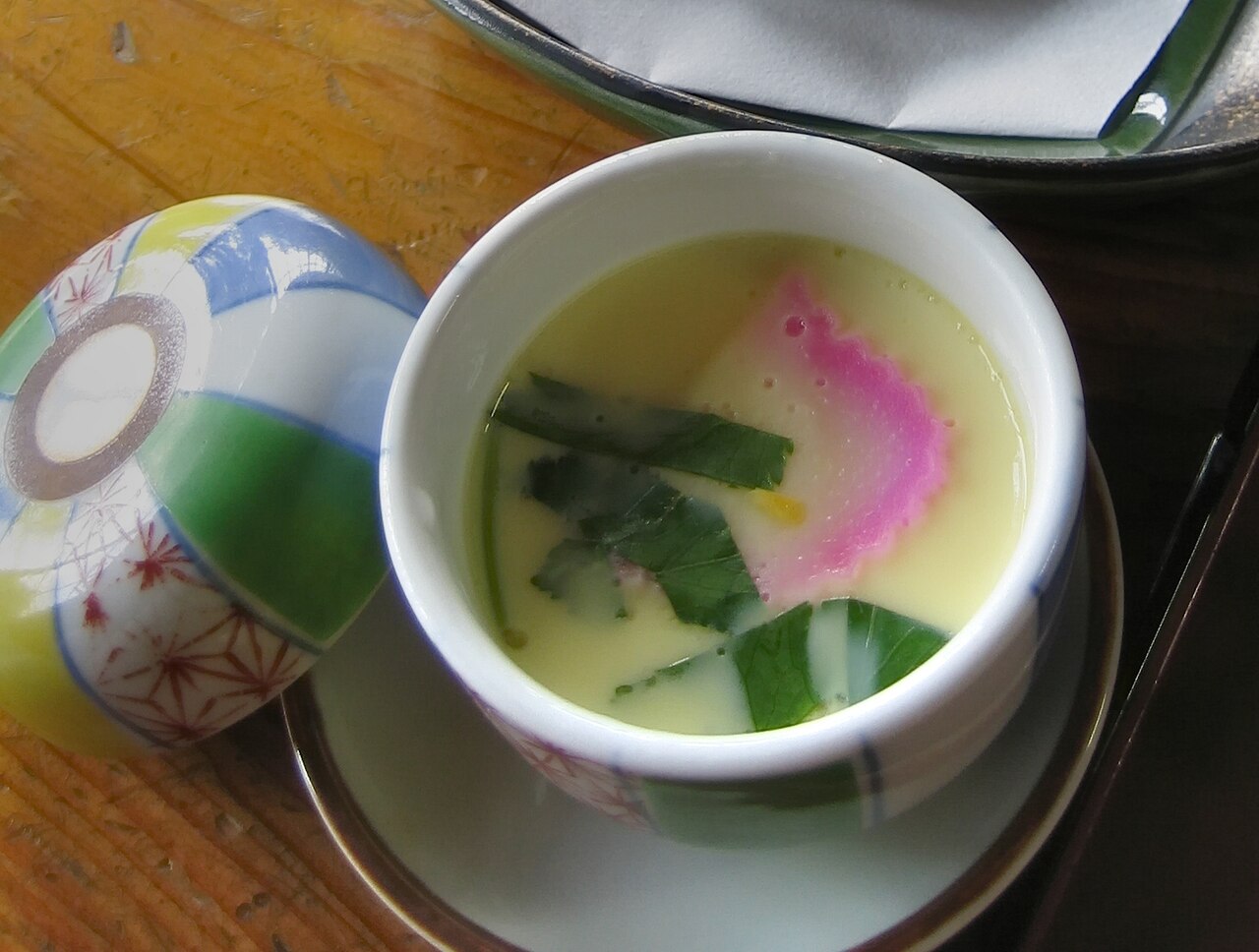
Chawanmushi (茶碗蒸し — Japanese)
Beaten egg + dashi in a 1:2.5–3 ratio (more dashi = silkier, less egg-forward). Strained through fine mesh to remove chalazae and air bubbles — this is what produces the mirror-smooth surface. Seasoned with mirin + shoyu. Pour into lidded tea cups or ramekins. Steam on very low heat, 12–15 min. The lid prevents condensation from dropping back onto the surface (which creates pitting).
Atitlán approximation: replace dashi with mushroom-kombu broth (dried shiitake + strip of kombu soaked overnight). The umami profile is close. Lidded bowl or plate on top of the ramekin for the condensation prevention. Steam on lowest possible gas flame.
Gyeran-jjim (계란찜 — Korean Steamed Egg)
Similar to chawanmushi but different texture target — looser, more custardy, almost spoonable. Ratio around 1:1 to 1:1.5 egg:liquid. Cooked in a clay ttukbaegi (earthenware pot) that retains heat and keeps the egg bubbling gently at the surface. Often topped with sesame oil and green onion at service. Less precise than chawanmushi — the clay pot's thermal mass is part of the technique.
Zhēng dàn gēng (蒸蛋羹 — Chinese)
Beat egg, add warm (not hot) water at 1:1.5 ratio. Add salt, sesame oil. Steam 8–12 min. Finish with soy + sesame oil at the surface. Target texture: the surface should be perfectly flat, like aged tofu — no bumping, no pitting. Cover during steaming to prevent condensation drops. Use warm water (not cold, not hot) to prevent separation during steaming.
Cured Eggs
Shoyu Tamago (醤油卵)
Soft-boiled (jammy center — 7 min for criollo at altitude), peeled, placed in a bag or jar with a marinade: soy sauce, mirin, sake (or white wine), optional sugar, optional star anise. Minimum 4 hours. Maximum 3 days (shell-off eggs absorb and can over-salt). The soy penetrates the white completely; the yolk darkens at the surface and stays golden-jammy inside. Standard ramen topping. Excellent on rice or as a snack eaten cold.
Local version: replace mirin + sake with a small amount of piloncillo dissolved in water + splash of ACV. Not identical but in the same conceptual territory.
Salt-Cured Yolk (Dried)
A technique from Southeast Asian and Taiwanese cooking (鹹蛋黃): separate raw egg yolk carefully onto a bed of salt (either dry, or in a saturated brine). Bury with more salt. 4–7 days refrigerated. The yolk dehydrates and firms into a dense, savory, slightly crumbly sphere with an intense flavor — described as a concentrated egg-umami, slightly funky. Used as a finishing element: grated over pasta, rice, noodles, or ramen in place of cheese. In Taiwanese cooking, incorporated into mooncake filling (the orange sphere in the center of a lotus paste mooncake). Worth experimenting with criollo yolks — the deeper fat and carotenoid content may produce an even richer result.
Century Egg (皮蛋 / Pídàn) — Context Only
Preserved in a strongly alkaline medium (traditionally: wood ash, salt, clay, quicklime; now typically: lye solution). The high pH denatures and gels the proteins: white becomes a translucent black-green gel, yolk goes creamy dark green-grey with a complex, ammonia-adjacent smell that is actually sulfurous protein byproducts under extreme pH. This is not a home project — the lye is dangerous and the process takes weeks. Context: on a menu in GC Chinese restaurants, possibly at GC Asian grocery.
Egg as Binder
When you add egg to a mixture that will be shaped and cooked, you're relying on the protein in the egg to coagulate under heat and hold the shape.
How much egg: 1 egg per ~250g of ground/mashed material is a starting point. More egg = more cohesion, more rubbery texture. Less = falls apart more easily, more tender.
Whole egg vs yolk only: yolk binds through fat and emulsification (less structural than white). White binds through coagulated protein (stronger, tougher). Most binders use whole egg — the combination is more useful than either alone.
Applications in this kitchen: lentil patties (Berzio R56 Silpancho), mushroom patties (R75 Bún Chả Chay), palmito cakes, tapioca batter (egg here is both binder and leavening via steam).
Egg as Emulsifier
Yolk contains lecithin, a phospholipid that can bridge oil and water molecules — one end attracted to water (hydrophilic), one to fat (hydrophobic). This lets you create stable emulsions.
Mayonnaise / alioli: oil dripped slowly into beaten yolk (with an acid — lemon or vinegar — to stabilize the initial drop). The slow drip is essential: too fast and the oil droplets don't get fully surrounded by lecithin molecules before the next ones arrive, and the emulsion breaks. Broken mayo: add a fresh egg yolk to a clean bowl, slowly whisk the broken mixture back in — the fresh yolk's lecithin rescues it.
Hollandaise / béarnaise: egg yolk + clarified butter + acid. Yolk emulsification in warm temperature — the challenge is keeping it warm enough to emulsify but not so hot the yolk scrambles (~60–65°C is the target). Double boiler (bowl over simmering water) manages this. At altitude, water boils at 94°C, so the double boiler is slightly less aggressive — the steam bath will heat the bowl to roughly 80–85°C, still safe for hollandaise if you're attentive.
Egg as Foam
Egg whites can be beaten into stable foam because the proteins (primarily ovalbumin and ovotransferrin) denature during mechanical action, forming a film around air bubbles that holds structure.
Room temperature matters: cold whites whip; they just take longer and don't achieve as much volume. Room temperature whites whip faster and higher — proteins at room temp are slightly more unfolded and more available to form the foam film.
Foam Stages
- Foamy — large, uneven bubbles, unstable
- Soft peaks — tips droop
- Firm peaks — tips hold, still glossy
- Stiff peaks — tips hold, matte (slightly dull); foam is at maximum stability
- Over-beaten — grainy, dry-looking, begins to weep liquid; the protein network is over-set and contractile
Uses: soufflé (folded whites give structure — don't overmix), génoise (whole eggs beaten with sugar over gentle heat to ribbon stage), meringue (French = raw whites + sugar baked; Italian = hot sugar syrup poured into beating whites, more stable), whipped whites as leavening in waffles and soufflés.
What to Do with Cracked or Extra Eggs
Cracked criollos at market: negotiate a discount, use immediately. Not for hard-boiling — the shell is compromised. Best for: omelets, batter, scrambled, beaten into soup.
Extra yolks (after using whites for a foam): custard, hollandaise, mayo, pasta (if you make fresh pasta), shoyu tamago, salt-cured yolk experiment, or add to scrambled eggs for richness.
Extra whites (after using yolks for custard or mayo): meringue, French omelet (will be tougher, less rich), pavlova, adding to egg drop soup, freezing for later (whites freeze well; yolks don't unless mixed with salt or sugar first).
Salt Before vs After Debate
Salting beaten raw eggs before cooking: draws moisture out from the protein chains, loosens the protein network slightly. The effect: scrambled eggs cooked from pre-salted egg are slightly more tender and wet-looking initially, but some argue it makes them weep more liquid.
Salting at end of cooking (off heat) is the standard French position. The pro-early-salt (Serious Eats) and pro-late-salt (traditional French) schools both have empirical support. The difference is real but subtle. For criollos, which already have dense protein structure, early salting tends to produce a slightly more tender result — worth trying.
Cross-References with Rice Noodle
Pad Thai
Egg goes into the wok after tofu browning, before noodles. Scramble 70% done, then fold soaked rice noodles into the half-set egg — the egg coats and lubricates the noodles. See rice-noodle wok technique.
Cantonese Ho Fun + Egg
Fresh flat rice noodles stir-fried with egg, soy, sesame. The egg goes first, noodles fold into it. The egg is both flavor and anti-sticking agent for the noodle.
Egg Drop into Rice Noodle Soup
Raw egg cracked into the bowl with hot broth, or stirred into the pot. Broth must be near boiling for a clean ribbon set. See rice-noodle — egg drop section.
Cheung Fun with Egg
Steamed rice noodle sheets with egg cracked in during the final 30 seconds of steaming. Rolls around the half-set egg.
Historical Background
East Asian Custard (Ancient)
- 蒸蛋羹 / zhēng dàn gēng (China) — Ming dynasty. Beaten egg + warm water/stock 1:1.5, steamed in bowl.
- 茶碗蒸し / chawanmushi (Japan) — Edo-period refinement with dashi.
- 계란찜 / gyeran-jjim (Korea) — clay ttukbaegi, served still bubbling.
- trứng hấp (Vietnam) — with bean thread noodles.
Tea Eggs
茶叶蛋 / cháyè dàn — Tang dynasty. Hard-boil, crack shell in pattern without removing, simmer hours in tea + soy + star anise + cassia + Sichuan pepper. The marbling under the shell is the point.
Western Steam Methods (Recent)
Mostly 2010s English-language codification: Kenji López-Alt (Serious Eats, ~2014), Cook's Illustrated, Instant Pot 5-5-5 (~2016). Older: oeufs en cocotte / shirred (19th c French bourgeois), ash-roasted eggs (Roman + medieval, survives in Bedouin/Andean), onsen tamago (Japanese hot springs, same trick in Icelandic geothermal).
Atitlán Sourcing
- Criollos in San Marcos: Doña Marta on the path to Tzunanijay (Sat morning); Don Manuel near Pana Pana sometimes has a basket. 6–12 at a time typical.
- San Pablo / Santa Clara markets: more reliable supply, slightly higher prices.
- Cracked criollos: ask for a discount, use immediately for tortillas españolas / batter.
- Commercial eggs: tiendas carry cartones (30 eggs) of white commercial eggs. More consistent size, less flavor, easier to peel.
Evolution Log
- v0.1 · 2026-04-26 — Initial huevos-bible.md: criollo vs commercial comparison, peeling science, hard-boil + steam methods and times, historical custard tradition, Atitlán sourcing.
- v0.2 · 2026-05-12 — Migrated to bibs system. Major expansion: fried (all styles), scrambled (French/American/Chinese), poached (standard/vortex/ramekin/plastic-wrap/63°C), shirred/baked (cocotte, huevos en chirmol, rancheros divorciados), omelet families (French/tamagoyaki/tortilla española/Guatemala-specific), egg drop technique, custard family (chawanmushi, gyeran-jjim, zhēng dàn gēng), cured eggs (shoyu tamago, salt-cured yolk, century egg context), egg as binder, egg as emulsifier, egg as foam, salt-before debate, freshness-by-application table, room temp principle, rice noodle cross-references. HTML render added 2026-05-12.